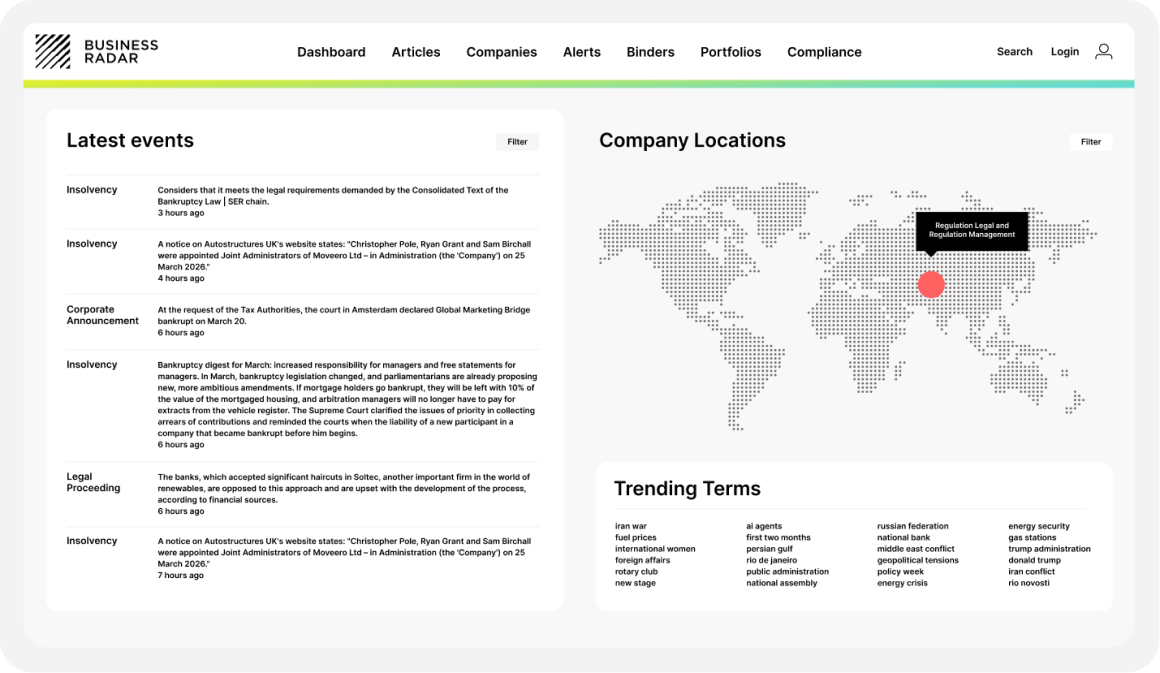


Financial crime compliance built for continuous scrutiny

FATF, the EU's incoming AML single rulebook, and the 6th AMLD require financial institutions to screen customers continuously, assess risk with evidence, and prove their programmes work under supervision. Business Radar gives compliance teams the adverse media intelligence, sanctions screening, and audit infrastructure to do exactly that.

350+

Global sanctions and enforcement lists including OFAC, UN, EU, and HMT

100K

Validated news sources — the early-warning layer that official lists can't provide

210+

Risk categories aligned to FATF typologies and AML/CFT designated offences

2027

EU AML single rulebook applies from July 2027 — prepare your programme now

Risk signals official lists miss

Adverse media & sanctions

The early-warning layer that official lists can't give you

Financial criminals appear in the news before they appear on sanctions lists. FATF and 6AMLD mandate adverse media as part of EDD — and AMLA's supervisory model will expect institutions to demonstrate it works. Business Radar provides genuine global coverage with the signal quality to act on.

  • 100,000 validated sources with automatic translation and deduplication
  • Screening against 350+ global sanctions and enforcement lists
  • Context-based entity matching to minimise false positives across similar names
The early-warning layer that official lists can't give you
Entity & ownership intelligence

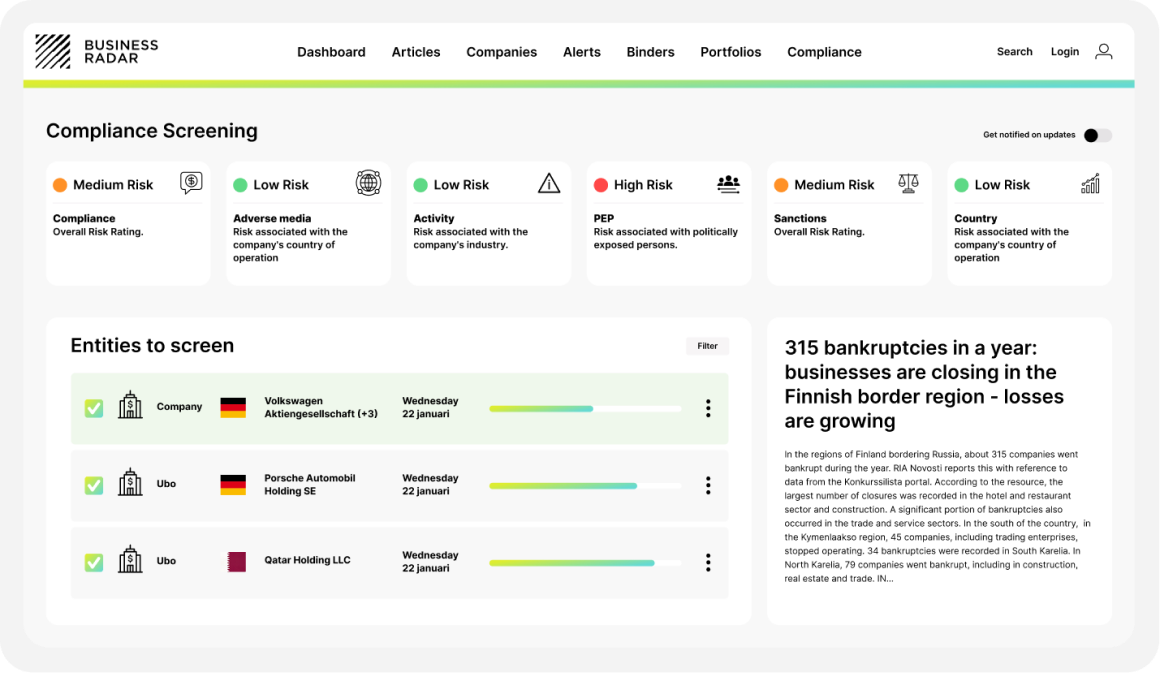
See who you are really dealing with, through the full ownership chain

Financial crime hides behind layered ownership. Business Radar's corporate linkage and UBO data show the companies and people behind every customer and counterparty, so enhanced due diligence rests on facts.

  • Corporate linkages and UBO data via Dun & Bradstreet
  • Global ultimate ownership visibility for EDD
  • Mass entity import for screening across your whole portfolio
See who you are really dealing with, through the full ownership chain
Audit-ready documentation

Every alert documented. Every decision defensible.

When regulators review your AML programme, they ask what you found, when you found it, and what you did about it. Business Radar keeps that record complete, so you can show your work.

  • Full audit trail: timestamps, source data, risk classification, user decisions
  • Exportable reports for regulators and internal audit
  • A defensible record behind every compliance decision
Every alert documented. Every decision defensible.

Related national frameworks

CSDDD builds on supply chain laws already in force across Europe. These apply now — independently of the CSDDD timeline.

  • German Supply Chain Act (LkSG)

    In force since 2023 for companies with 1,000+ employees in Germany. Requires annual risk analyses, preventive measures, and a complaints mechanism. Applies independently until Germany confirms alignment with CSDDD scope.

  • French Duty of Vigilance

    Applies to companies with 5,000+ employees in France or 10,000+ globally. Requires a published annual Vigilance Plan covering risk mapping, supplier assessment, and a monitoring scheme.

  • UK Modern Slavery Act

    Applies to any company operating in the UK with global turnover above £36M. Requires an annual statement on steps taken to ensure modern slavery is not present in supply chains or operations.

See how we fit your CSDDD programme

Whether you're building due diligence infrastructure from scratch or stress-testing what you already have, our team can walk you through how Business Radar maps to your obligations.

Questions we get frequently and their answers

Why do we need adverse media if we already screen against sanctions lists?

Because financial criminals appear in the news before they appear on official lists. Sanctions and enforcement lists are confirmation, not early warning. FATF and 6AMLD expect adverse media as part of enhanced due diligence, and Business Radar provides that layer: 100,000+ validated news sources screened alongside 350+ global sanctions and enforcement lists, including OFAC, UN, EU and HMT.

How do you keep false positives under control across similar company names?

Business Radar uses context-based entity matching rather than simple name matching. Signals are verified against the actual company, its location and its corporate context before they reach your team, and automatic translation and deduplication mean the same event doesn't hit your queue five times in five languages.

Can you screen beyond the direct counterparty?

Yes. Financial crime hides behind layered ownership, so Business Radar unfolds corporate linkages and UBO data, via Dun & Bradstreet, to show the companies and people behind every customer. You get ultimate ownership visibility for EDD and can mass-import entities to screen your whole portfolio at once.

Will this hold up when regulators review our AML programme?

That's what it's built for. Every alert carries a full audit trail: timestamps, source data, risk classification and user decisions. You can export reports for regulators and internal audit, so when supervisors ask what you found, when you found it and what you did about it, the record is already there.

How does this prepare us for the EU AML single rulebook and AMLA supervision?

The single rulebook applies from July 2027 and AMLA's supervisory model will expect institutions to demonstrate that their monitoring actually works, not just that it exists. Business Radar's risk categories are aligned to FATF typologies and AML/CFT designated offences, and the documentation trail gives you the evidence layer supervision requires.

Can we integrate this into our existing KYC workflow?

Yes. Use the platform directly or bring signals into your own systems via the API and exports. Batch upload means you can load your full customer portfolio and start continuous monitoring immediately, rather than screening one entity at a time.